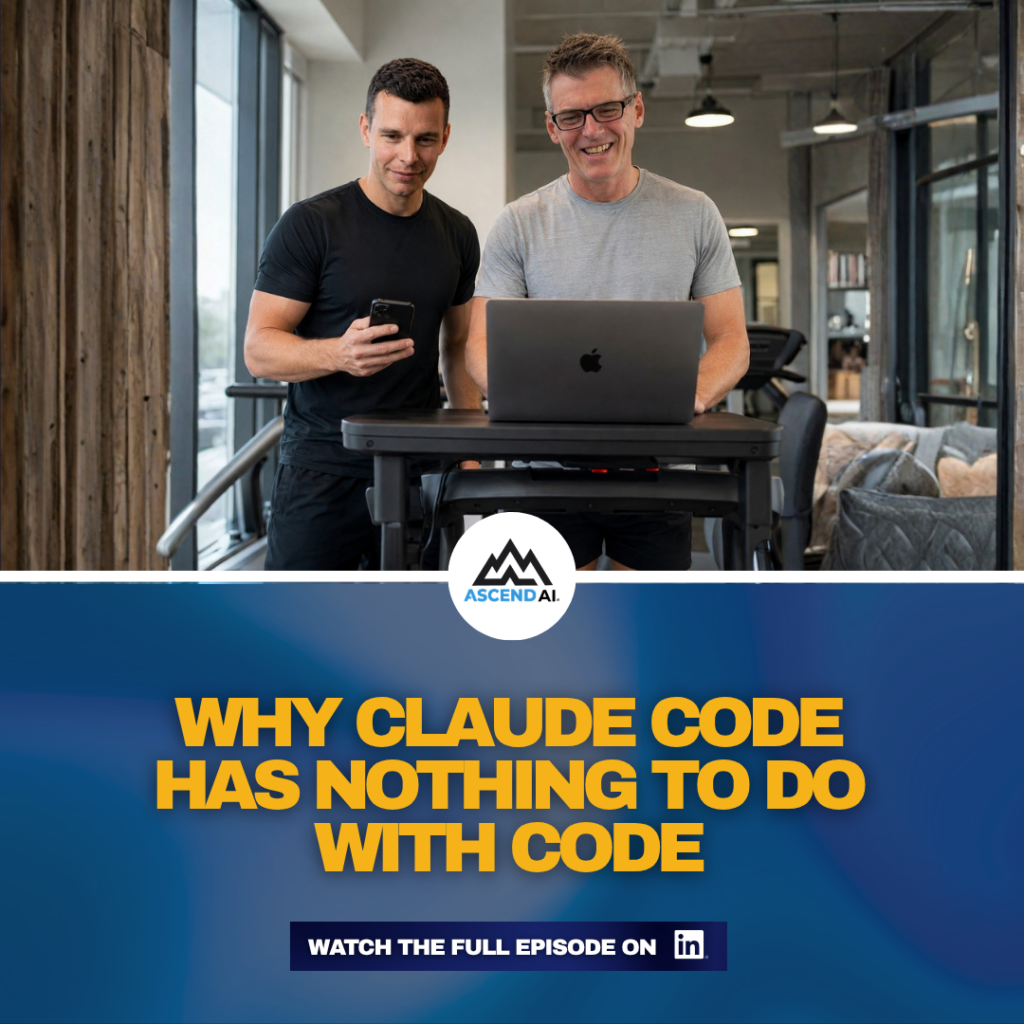


When Anthropic named their agentic tool Claude Code, they made a decision that cost every non-developer one of the most powerful productivity applications available right now. The name did exactly what bad names do: it told a large portion of the people who would benefit most from the tool that it wasn’t built for them. Executives closed the tab. Strategists kept prompting in the regular chat window. Operators assumed it was a developer problem. None of that was true.
Claude Code for non-developers is not a stretch or a workaround. It’s actually what the tool is for.
Listen to the full conversation with Matt Graham from Rapid Dev:
What Claude Code Actually Does (And Why the Name Misleads)
At its core, Claude Code does one thing that the regular chat interface does not: it runs recursive, goal-oriented loops. You define the output you want. The system works toward it iteratively, checking itself, correcting, and continuing sometimes for hours without you sitting there feeding it the next prompt.
That capability was first applied to software development. You set a goal like “build this feature,” attach quality controls that the output has to pass before it moves to the next step, and let it run. The loop catches its own errors. It doesn’t proceed until it meets the standard. It can handle sequences that would take a developer dozens of individual prompts to manage manually.
But the loop logic doesn’t know it’s supposed to be writing code. It’s just iterating toward a defined goal with quality gates along the way. And that works on a strategic plan just as well as it works on an app.
As I put it on the podcast: “The same technologies that were used in Claude Code can be used for qualitative tasks and development. Maybe it’s a marketing plan or a strategic plan or whatever it is.”
The issue is almost entirely one of perception. Because the tool was introduced to the world as a coding tool, and because most of the early press around it focused on software development, the people who could benefit most from goal-oriented AI prompting never had reason to investigate.
The Difference Between a 20-Minute Output and a Two-Hour One
Here’s what the current best practice looks like for most skilled AI users approaching a complex deliverable: they open Claude or GPT, they build context carefully, they load relevant documents, they craft a prompt asking for the best version of whatever they need a business plan, a competitive analysis, a go-to-market strategy and they hit submit. Twenty minutes later, they have a pretty good document.
That’s a meaningful improvement over writing it from scratch. But it’s still a single pass.
Now think about what goal-oriented AI prompting adds to that process. Instead of one pass, the system runs multiple iterations. It can apply what amounts to a steel-man review forcing itself to argue against its own conclusions before locking in a section. It can check internal consistency across the entire document. It can pass sections through quality gates before moving forward. What took 20 minutes now takes two hours, but the two-hour output has been stress-tested in ways the 20-minute output never was.
For knowledge work, this is a significant shift. Financial analysis, strategic planning, marketing briefs, and scenario modeling all benefit from the same iterative hardening that makes software more reliable. The process is the same. The output is just words and frameworks instead of functions and features.
The practical entry point is the /goal command in Claude Code. Rather than writing a task-by-task prompt, you define what the finished output is supposed to look like and let the system figure out the path. Writing a good goal prompt is itself a skill I typically use Claude to help me draft the goal statement before I run the loop but it’s a learnable skill that doesn’t require any technical background. What it requires is the ability to think clearly about outputs, which is something most senior leaders are already good at.
Why This Matters More Right Now Than It Did Six Months Ago
The timing here connects to something broader. The AI tools available to business leaders have quietly crossed a threshold. Individual productivity use chat-based prompting, document drafting, summarization is well understood. Most organizations have people doing some version of this. The frontier has moved.
Goal-oriented AI prompting sits at the next layer. It’s not agentic orchestration across complex systems. It doesn’t require developers or infrastructure. It’s one person, one tool, and a different way of thinking about how to use it. The loop does the heavy lifting. The human sets the standard.
This also matters in the context of where provider risk currently sits. The regulatory environment around AI is fragmenting fast. Export controls, government investigations, and platform instability are all real variables that businesses building on a single AI provider need to take seriously. The answer isn’t to stop using AI. The answer is to build habits and workflows that are portable that can run on a different model if the primary one becomes unavailable. Goal-oriented prompting, applied to qualitative work, is exactly that kind of workflow. The output logic doesn’t change when you swap providers.
Matt Graham put it well in our conversation: building a database of known good outputs so you can test efficacy across models isn’t just a technical quality move. It’s a continuity move. For organizations that have been building on a single provider without a fallback, that discipline is increasingly worth developing.
The Real Barrier Is Never the Tool
I want to be direct about something, because I see this pattern constantly with the organizations I work with. The reason most executives haven’t explored Claude Code for non-developers isn’t that the tool is too complex. It’s that the name told them to look somewhere else.
That’s a framing problem, not a skill problem. And framing problems are fixable in about ten minutes.
The deeper issue one that shows up in every organization I work with, from a twenty-person fashion brand in Los Angeles to a technical software team running hacker houses in Istanbul is that people keep waiting for the right moment to develop new AI habits. They’re waiting until they understand it better. Until the tools stabilize. Until someone gives them a clear roadmap.
The first time you use /goal on a qualitative deliverable, it’s an adventure. You’re figuring out how to frame the output, how long to let it run, what quality gates actually make sense for the work. The second time, you’re learning. The third time, it’s just how you produce that kind of document.
That progression doesn’t start until you start. The tool has been sitting there the whole time.
If you want to understand where your organization actually sits on this curve what you’re already doing well, what the next practical move looks like, and where the real friction points are I built a free assessment for exactly this: Take the AI Readiness Assessment
And if you want to talk through your specific situation, I set aside time every week for these conversations: Book a conversation with Kevin
No pitch. Just an honest look at where you are and what would actually move things forward.