Ep #17 You’re Using Meeting Recordings Wrong, Shadow AI and How Block Cut 4,000 Jobs
•AI at Work, AI in Business
Audio episode
Listen to this episode
Shadow AI use is creating massive compliance risks that most organizations don’t even know exist yet. In this episode, Kevin Williams and Eli explore why the Anthropic-Pentagon situation should be a wake-up call for every business leader dealing with AI adoption.
We dive into the reality that every company has employees using free AI models for work tasks, creating exposure that legal teams don’t understand. From Jack Dorsey cutting 4,000 jobs at Block to the emergence of new roles like AI Product Managers and Workflow Engineers, this conversation covers both the risks and opportunities of our current AI moment.
The episode also explores the enterprise context graph opportunity – how virtual companies have an advantage in surfacing “dark arts” knowledge that only lives in individual heads, and why most companies will need to start recording everything.
Key Topics Covered: Shadow AI compliance risks and vendor volatility Why AI policies don’t match reality in most organizations The enterprise context graph and capturing organizational knowledge New AI-era roles: Product Managers, Process Engineers, Workflow Engineers Jack Dorsey’s 4,000-person layoff at Block and AI washing Legal compliance challenges with recording and surveillance tech The gap between AI capability and actual adoption
APPROXIMATE TIMESTAMPS: 00:00 — Intro and weekend updates 03:13 — Anthropic vs Pentagon situation breakdown 11:23 — Shadow AI compliance risks in organizations 16:24 — Recording technology and legal implications 25:02 — Jack Dorsey’s Block layoffs and AI washing 33:48 — Middle management displacement and knowledge sharing 36:07 — Enterprise context graph and dark arts knowledge 42:13 — Jobs of the future: AI Product Managers and Workflow Engineers 45:32 — AI capability vs adoption gap analysis
Elijah Szasz · Passage 1What's up, Kevin? Good, good. Did you get out of your house away from your computer and touch grass or snow this weekend?
Kevin Williams · Passage 2Hey man, how's it going? I did, I did. It's a really weird year in Park City and it's like, you know, 60 degrees. So you ski in the morning and you hang out in the afternoon. It's not really supposed to be this way mid-March, but it is.
Elijah Szasz · Passage 3It's no, no, it's wild. Yeah, I actually took my kids to the Salt Lake City Zoo. Have you been to that one? It's not great. It's yeah, it's not great. I don't know. I've lived in other big cities and not a real big fan of that zoo. You know, they are down to only one animal. Like, that's it. They have a single dog. It's a shit zoo, It's a shit zoo, Kevin.
Elijah Szasz · Passage 5had to get a little analog and actually go see real animals because I was helping my son with a school assignment where he had to write a product spec for a robot that mimicked an animal that might be able to help the environment with some issue. And by product spec, mean, like fill out an eight by 11 piece of paper with like five questions. And of course I suggested like an AI powered nanobot that would take control of the brains of someone in our current administration who's actually intent on destroying the environment. I thought that'd be the. Shortest distance between two points, but I backed off because we're in Utah and you know I don't want to get him kicked out of sixth grade Which he's probably gonna figure out how to do on his own anyway
Kevin Williams · Passage 6So I want to know if the dad joke was written by GPT-54. We can jump right in.
Elijah Szasz · Passage 7I don't think it's that good. It would give you something really bad. You'd make a correction and then it would say, you know what? That's actually such a better joke. I really like your joke better, Kevin.
Kevin Williams · Passage 8I'm ⁓ You know, we're three and a half years into this. And one of the things that I wish that I had done is to create my own like marker prompt so I could track progress doing the same thing. And I think that dad jokes would have been one of them. know, Ethan Malik has this thing where, Ethan Malik is a professor of entrepreneurship at, ⁓ Wharton. ⁓ you haven't followed him, you should totally follow him. He's reasonable and he's smart and he's, he's not into the hype. but he's deep in it.
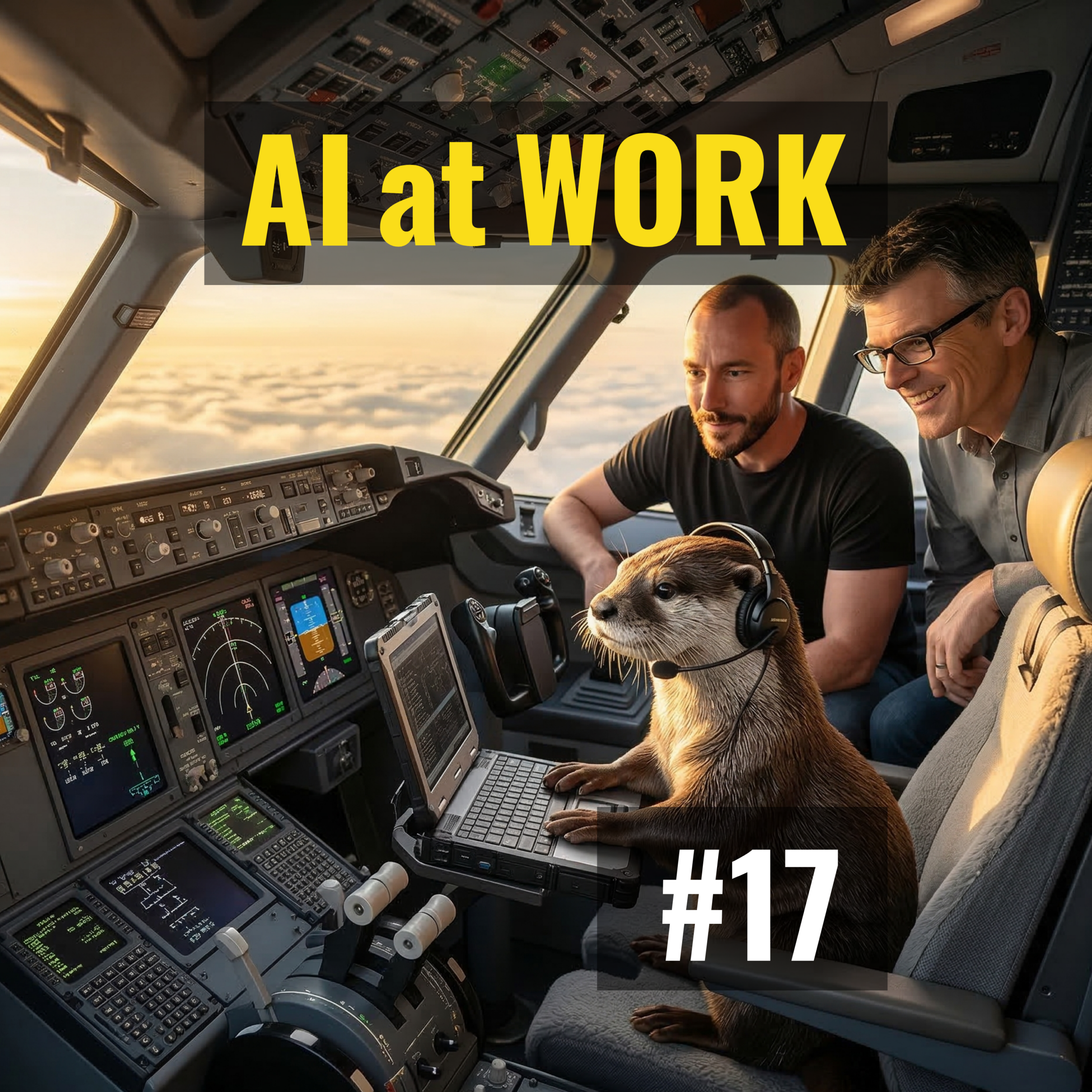
Kevin Williams · Passage 10But he runs in images, runs images, an of an otter on a plane, like working on a laptop or something like that. ⁓ And how it's evolved over the last three and a half years is absolutely amazing. ⁓ At point, the otter's like flying the plane. ⁓
Kevin Williams · Passage 12exactly. I hesitate think what a ⁓ GPT dad joke would have been, but at the time we both would have been like, wow, that's amazing. ⁓
Elijah Szasz · Passage 13I know. This is incredible. taking my phone out at every family dinner to get some of these. This is gold. ⁓
Kevin Williams · Passage 14This is... at that point, we should have just like quadrupled down on Nvidia stock, but I didn't at least, you know. ⁓
Elijah Szasz · Passage 15I'm telling you, I'm telling you, if only I had that crystal ball. you know, I was looking at our notes from the last episode and we kind of started and possibly ended with what had happened with Anthropic and the Pentagon. And was thinking a lot about this over the weekend and just kind of the potential real AI at work implications of something like this. When I had a few things I want to bounce off you, but for those who don't know, and this is... an evolving saga, like a lot of stuff has happened in even the last few days with this. Do you want me to give a little breakdown about what happened, even though we don't get bogged down in the endless political soap operas, but this is just too big to ignore, I think. Okay. Okay. Elevator version. Basically, there is an ultimatum rolled out by the Pentagon to Anthropic Labs. And they basically told Anthropic they wanted completely
Elijah Szasz · Passage 17unrestricted unfettered use of clod for military purposes. And Anthropic pointed out that they have this red line, this kind of core safety principle that says that there's two things that we will not allow. One is the fully autonomous lethal weapons, like literally killer robots, terminators, without a human in the loop, and mass domestic surveillance. And so because Anthropic wouldn't drop those guardrails, the government then hit them with a ⁓ chain risk designation. And that label, historically is saved for foreign adversaries like Huawei. It's never ever as far as I know been actually designated to any US private company ever. And so the administration then ordered all federal agencies to stop using Anthropix tech. And this first came out as a tweet from Trump on truth social, think, right? So everyone's like, is this happening? I don't know. Lockheed Martin said, well, I guess it is. Like, I believe social media and they stopped using it or they said they did. then there's a lawsuit. So just on Monday, and we're recording this on Tuesday, so just yesterday, Anthropic officially sued the government calling this an unlawful campaign of retaliation and a violation of their First Amendment rights. And what's is a bunch of the rival AI researchers, including like ⁓ Google's AI guy, ⁓ Jeff are actually backing Anthropic on this. and they're warning that this is going to completely stifle US innovation, these kinds of unwarranted supply chain designations. So that's what happened. And the first thing that came to mind, if you are in the middle of or have been deploying AI in your workplace or even you personally, volatility. is real, right? So like imagine you're a midsize contractor doing any work remotely connected to the Department of Defense, and you just spent the last year building your whole internal workflows, your agents, your document processing all around cloud because it's the best model out there, right? Or else it wouldn't be so interested in it. And then overnight, the government says you got to rip it out and prove that you're not using it. So, you know, what's the lesson there? You can't afford to be single threaded on any one AI model. And we talk about this all the time. What are your thoughts on that, Kevin?
Kevin Williams · Passage 18I mean, first, it's sort of funny. So my background, to some degree, is in supply chain and managing global supply chains way back. But you always want dual source of supply. And somebody's can catch on fire or whatever it is. And in this case, the factory that caught on fire is anthropic. ⁓ And at our own scale or in ⁓ ascent,
Kevin Williams · Passage 20Yeah, all of a sudden we're having to build features into our internal products and our external products that flag outages because the other thing that happened over the last week is there was a lot of instability in Claude. Frankly, there was a lot of consumer movement. like millions of people moved from GPT to Claude, they're voting with their dollars. Cool. Good for them. But that Claude to become unstable. So the first thing that we had to build was instability warning so that we knew when the apps were misbehaving because of that, which is not something that's really been a problem up until now, at least in the last year or so. And on the other side is the parallel architecture. And this is probably good in terms of resilience because now everybody's going to need to be building model switching technology into it. But it may be bad in terms of the commodification of the different models. That as the models converge on standard features and standard approaches, and I'm sure we'll talk about GPT-54 later, they're all getting more similar over time. And that will allow your prompts to be interoperable with multiple models. ⁓ it also means that your switching costs really drops to almost nothing. which will eventually create market pressures, which will lower the cost of tokens. And for you and I and the consumers, that's all probably pretty good and we'll all end up with better, more robust systems. But they're more complicated to build right now because you're going to have to test them on multiple models and figure that stuff out.
Elijah Szasz · Passage 21That's right, yeah, yeah. mean, super, super good points. I also was thinking about just how terms of service actually ⁓ have right? Like ⁓ this real, it can be enforced whenever you want. There's a South Park episode that I was reminded of about the terms of service and ⁓ the awful that ⁓ might happen you if you just blindly click accept. But when you do click accept, proving that they'll literally risk hundreds of millions of dollars in government contracts to stick to ethical guardrails. And if you're bringing these tools into your enterprise ⁓ you don't deeply understand the providers acceptable ⁓ because they will enforce them even against the US military, bad things could Things could go sideways really fast. I feel like you as the fun killer, Kevin, ⁓ Mr. Regulatory. probably have bumped up against us somewhere. I know it comes up a lot in health care, for example, as far as the acceptable terms of use. of the powerful things about having these models at your disposal is you can literally just paste it all in there and actually talk to the models about what's allowable. It's put in the kibosh on me a couple of times. We had a discussion where one of my workflows just got stopped because it said, ⁓ that violates the terms of service of a platform that We don't even own, but we're still not gonna let you do it. Like interesting, interesting. So that was another thing I was thinking about as well with this.
Kevin Williams · Passage 22I'm going to laugh a little bit because the very first custom GPT I ever built was a terms of service analyzer for that reason so that I can understand it. And adjacent to that is an SOW, a statement of work analyzer, because the other thing that we bump into a lot are corporate councils who have put very overly broad language into their contracts that
Kevin Williams · Passage 24basically would make it impossible for me to use any sort of LLM. have to be able to build things. You hired me to build an LLM solution. ⁓ and behold, I'm going to have to connect to an LLM to do that. ⁓ you're not going to pay for the enterprise version or some custom model. ⁓ this stuff is real, and it happens all the time. So these are great uses for just super basic ⁓ AI work applications of like, put the terms of service in there, see how the organization is going to use your data. And if you're a service professional, like a consultant, you better be looking at your contracts and making sure that some council hasn't put something in that contract that makes it impossible for you to use your workflow tools.
Elijah Szasz · Passage 25Totally, totally. The last thing I'll drop in here that will connect what you might be doing at work to the Pentagon is we always talk about shadow IT, right? Shadow AI use. ⁓ about the Pentagon right now. So we are ⁓ involved in a war in Iran that doesn't really seem to have much of an off ramp in the near future. ⁓ the Pentagon doesn't really seem to have a very clear off ramp to using. flawed that war, right? So they are ⁓ designating them a supply chain risk, yet they are the only approved model that is currently active in the Pentagon's ⁓ different using this tech. For some pretty awful things actually, too. ⁓ Some stuff came in the news that it might have made some pretty horrible mistakes. So I mean, we talk about shadow AI use all the time and employees basically secretly sharing tools that leadership doesn't know about. And if your company is mandated to stop using a specific tool for compliance or regulatory reasons, Joe in accounting is still tunneling into cloud on his personal device to do his spreadsheets, then your entire organization is now carrying massive compliance risk. And so as Fun Killer, this is something that you talk about pretty often, right? ⁓ Like shadow ⁓ AI and the implications it can have.
Kevin Williams · Passage 26you Whoever's whether you it or not, pretty much everybody in your organization is using AI. ⁓ And think to your own reaction when you were forced to pay for it. ⁓ my gosh, I'm going to pay $20 whole dollars a month for this supercomputer that can do anything, images of others on planes. And there's like a lot of consumer resistance as far as people actually paying. So people are bringing these free models into your organization. So at a very basic level, everybody listening has people in their organization today who are using free models, hopefully not free Chinese models, ⁓ do things in your organization that they probably shouldn't be doing. So there's a base level of risk everywhere. ⁓ then it just multiplies up. as far as being an organization that's dealing with sensitive data of some kind, healthcare data, insurance data, whatever it might be, or contractual information or whatever, there's be such a comeuppance in the next few years that ⁓ I even know where to start. Like, I don't think the lawyers even understand where to start. They've gotta be gnashing their teeth looking for the right sort of opportunities. You are actually seeing like blanket, trolls like class action trolls that are starting to pop up on social media. ⁓ boy.
Kevin Williams · Passage 28This happened to a good friend of mine this week that he runs a really cool like vintage t-shirt company. It's been around for a long time somebody is running an ad join a class action against this brand and it something to do with a truth and advertising claim or something along those lines, ⁓ but it doesn't make ton of sense. And it's shocking because they're buying Facebook ads. And anybody who knows anything about digital media knows that Facebook ads are not particularly cheap. So they're a net to ⁓ people into this class action against this little brand that came out of nowhere. ⁓ Yeah. that's slightly different. these liabilities are piling up. And ⁓ that general counsel who wrote that crazy policy that's
Kevin Williams · Passage 30was not particularly well thought through is like, yeah, well, I was right because of all of this. OK, you were right, but the policy isn't in alignment with reality the organization isn't in alignment with your policy. ⁓ you're to have to straighten that out. And again, I hate to be fun killer on a Tuesday, ⁓ look. Put your own AI policy and your own terms through some prompting and ask it practical questions about your exposure. Hey, I'm working with this defense contractor. What is this all going to mean for me? And the answer is you probably have six months to disgorge it. So there's some nuance in this.
Elijah Szasz · Passage 31than a flight, ⁓ If the word prison comes in and those results like in the top couple lines and just yeah, try to stop everything. Like that's gonna be the end.
Kevin Williams · Passage 32Yeah. And you know, this goes further than that. I mean, I'm holding up a pair of AirPods in my hands and I'm wearing a nice set of Ray-Ban like glasses we have recording pretty much everywhere shortly. Like already you're starting to see the meta Ray-Bans that are out there. You hear about these new Apple devices and the OpenAI devices. ⁓ Yeah, go figure, right?
Elijah Szasz · Passage 33That's so weird that metal would come out with something that spies on everybody all the time. That's crazy.
Kevin Williams · Passage 34But what I don't understand, and maybe somebody can comment about this who's actually a lawyer, is not allowed to record public conversations in most states. Utah, yeah, it's pretty cool. You're to record pretty much anything. ⁓ Just tape shotgun mic to your shotgun. Yeah.
Elijah Szasz · Passage 35On your on your gun. I'm pretty sure you could just like put it on your rifle Yeah.
Kevin Williams · Passage 36But like California, imagine the circumstance that Eli and I are talking to each other. We're having a, you know, an animated conversation. He knows that I'm recording. I know that, that, that he's recording, but somebody's having like a family feud behind you and you're recording those people. And in California, that's called wiretapping it going to catch up as I. It's getting super murky as people are wandering around.
Kevin Williams · Passage 38Apparently the meta attorneys when they were summoned about some of their recording technologies, ⁓ all had the chutzpah to show up in ⁓ wearing their recording meta Ray-Bans. Like the judge noticed and was not amused. ⁓
Elijah Szasz · Passage 39I saw that. Yeah. Yeah. They all rolled in with the Ray man's just like, Hey guys. Yeah. Totally. Totally. I've had people show up to meetings with those. I full disclosure did buy a pair. I wanted them for content creating. Once I looked at that footage on a desktop monitor, like just going to return these like this looks like crap. yeah. Wasn't like out for the mass surveillance, but I have shown up to meetings and people are wearing them and it's yeah I mean geez is this the future I think it is because I feel like tons of people are now working on hardware that's going to be doing exactly that whether it's a of glasses or a little pendant or yeah where is where is where is compliance going to catch up to all of the stuff going on.
Kevin Williams · Passage 40Well, and the states and the federal government haven't aligned, and the federal government is threatening the states every time they do something that's viewed as blocking laws. So New York just enacted a law about ⁓ truth in advertising and AI, so AI disclosures and avatars. And so you're advertising in New York, but you're in Utah, so you're subject to the New York law. have to comply with all of this if you're a business that's operating nationally.
Elijah Szasz · Passage 41Like the early days of all the internet law, right? I mean, it was the same thing. had just like, California is going to have its own privacy act. But if ⁓ a seller and I'm ⁓ on internet, then that's the first one I have to comply with if I want to sell anywhere really. Right. So it's, it's, ⁓ it, a lot like that, but even more complex.
Kevin Williams · Passage 42Well, yeah, and it opens up that trolling argument. So now, not that I want to give the trolls any ideas, but they're ahead of the curve, right? Pretty easy just to look at every advertisement that's running in New York and have a bunch of plaintiffs that are flagging all of the AI-generated content that hasn't complied and creating some sort of auto-filing system against the individual brands. Like somebody's working on
Elijah Szasz · Passage 43Oh, they have plenty of ideas. Don't worry. They're all good. So wait a second. The complying part, just because I'm not up on this, so I'll just pretend that you are completely up on it and ask you, is that do you have to disclose in the advertisement that you're using synthetic media? Is that what it is? OK.
Kevin Williams · Passage 44Basically, and I don't have the granular details. I'm still trying to familiarize myself with it, including I'm not quite sure when it goes into effect and whether it has to be like right across the middle. This is an AI avatar or whether it's like, you know, this was AI generated at the bottom or whatever it might be.
Elijah Szasz · Passage 45I just finished a website and guess what I didn't use? A single real person or video or anything else. I'm wondering if will start to spill out into these marketing websites or marketing landing pages, right? Because another one of these nuisance suits that got really popular over the last couple of years was the ADA, the American Disabilities Act, right? And so ⁓ the the story goes is that ⁓
Elijah Szasz · Passage 47If I have any sort of disability, and I mean any disability, it could be ADHD, like your website is just too confusing or I'm colorblind, like I need this high contrast option. I mean, really anything, ⁓ you basically out of compliance, right? ⁓ And I think it was two different firms in New York City basically just went after ⁓ the country, right? And they... collected a pool of plaintiffs, it was like the same half a dozen people, and then they would just send out threat letters, right? Like hundreds of threat letters a day and say, pay us 10,000 bucks or we're gonna sue you and you're gonna lose because you are violating ⁓ ADA compliance laws, right? And there's companies that even popped up that would put a little layer over your website, like you could hit a little, you know, it looks like the chat widget in the bottom right hand corner, and then you could then pick, I want higher contrast or I want this or I want, you know, to move everything up here. I want pop-ups to be disabled. And they gave you a little control panel. And even with that, they said that there are still things that they could pick out where they could go after. Right. So it kind of turns into one of these things where does compliance look like across the broad scope of all of this murky now. That's it's getting really interesting.
Kevin Williams · Passage 48Okay, so it gets even worse than that. A couple of different things that happened. Well, first is ⁓ the ADA did not keep up with the internet. So ⁓ hasn't been revised to accommodate these issues. there's vagueness. ⁓ actually no legal compliance threshold ⁓ the act. It's just a matter of sort of best faith. And even if you did all of the things, ⁓ it's called what I think ⁓ something that. Even if you did all of the things they can still sue you you can say that you did the things and a judge might toss it out But you're likely to incur legal legal expenses They know that so they go after you to settle for two to five thousand dollars or whatever it may be
Elijah Szasz · Passage 49Yeah, exactly. Right. The settlement is always way better than cost of you going to defend yourself, which is what makes it just such a racket.
Kevin Williams · Passage 50And then the other part that just really got me is there were all these little companies that spun up that were helping people become compliant. they would add code to your site to hit all the compliance thresholds. So what ⁓ trolls did is they actually identified the code that those tools were using. ⁓ if you were using the tool, you had no claim of ignorance. Like you knew that your site needed to be compliant because you were paying this tool. ⁓ then it goes in front of a court and you might lose because ignorance not an excuse anyway, courts can more lenient about it, but that was a thing for a while. So actually it was worse to be using one of these tools than not to be using the tool. ⁓ And I what that's ⁓ gonna look here.
Elijah Szasz · Passage 51But some of the tools would indemnify their subscribers though. That's how they were selling it. They'd basically say, we will cover you up to a million dollars of whatever if you get sued. So now instead of a tool, you're really buying insurance policy.
Kevin Williams · Passage 52I mean, look close to just as this is an e-commerce podcast, but I believe one of those got sued into the ground and actually got shut down for false advertising. Something along those lines, yeah. Anyway, so all of this stuff is coming at us and sure ⁓ doing the best faith to be compliant. Like this is really gonna be a challenge. ⁓ think you're right as far as referencing like
Kevin Williams · Passage 54you know, adhering to California and New York, those are the giant markets. California usually leads as far as the regulations. So what is California going to require in terms of disclosures and making sure that your site or activity is disclosing if it's AI driven, you know, doing all of the things basically.
Elijah Szasz · Passage 55Yeah, yeah, yeah, it's gonna get a little messy. Wow, we went from the Pentagon to mass surveillance to compliance and like, was impressive. Wow, know what, I'm gonna keep the fun train rolling because even though there's a million things I wanna talk about, one of the things I wanna talk about because it plays into a bigger topic is buddy Jack Dorsey who famously founded X, the artist formerly known as Twitter.
Elijah Szasz · Passage 57He slashed 4,000 jobs at Block, which is the hold co for Square and Cash App. And so that equated to roughly 40 to 50 % of the entire company in a single day, like in a single day, just like, whoop, you guys are gone. he explicitly blamed AI, said that ⁓ intelligence tools like Opus 4.6 and Codex 5.3 ⁓ just compounding so fast at this point. that a much, much smaller team can now do more and do it better. And he said, yeah, all the other tech companies, like, I'm just a first mover. They're all gonna be doing this, right? And so it brings up this interesting point of the reality versus what's been known to become AI washing, right? Which is basically pointing to AI as the scapegoat for over hiring during the pandemic, realizing that you have way too much staff and then being like, Yeah, you know what? AI, you guys are gone. You lost your job. know, what's take on that, Kevin?
Kevin Williams · Passage 58Well the funny part is there's also... the other side of it, is just economic watch washing. So organizations that are totally clearing up people due to AI, but they don't want to end up in the media because they're, you know, they're moderately sized business and you lay off, you know, 500 people, thousand people, and they call their local news affiliate and they're like, Hey, I killed my job. And then the next thing you know, you're in the news cycle. So just calling it instability, share loss, all the other craziness that's going on in the world right now. leaning into it. That is happening every single day all over the place and people aren't paying much attention to it. The AI washing part is that you know I'm not an economic analyst I don't track block but my understanding is they probably did over hire and this was a this was a good opportunity for them just to clear it out but they sure did they the stock like and other companies have to pay attention to that like
Kevin Williams · Passage 60You know, there's, there's block versus whoever their competitor company is. And the competitor company analysts are saying, well, you guys are going to need to do the same thing. And this is where that flywheel starts turning a little bit. And the thing is that block wasn't unprofitable. This is a pretty healthy company. So it didn't necessarily have to do this, but internally it absolutely recognized that it could, which makes the AI washing part kind of irrelevant to me. Like they still cut 40 % or 50 % of their workforce. which means that they've put automations in place that are replacing those people by and large, whether it's replacing all of them or not, they are achieving a level of efficiency that made them feel comfortable with being able to do that. And we all need to be paying attention.
Elijah Szasz · Passage 61Yeah, for sure. It is really difficult to tease out what is posturing though, right? Because I mean, it's way easier and better for the stock price for a CEO to say, hey, we're the future. We're AI native company now, rather than saying, yeah, we hired way too many people during the pandemic and we put way too much faith in Bitcoin that shit the bed and now we've got to right the ship, right? ⁓ different narratives, going to be very different things to your stock price.
Elijah Szasz · Passage 63Morale, I don't know. I don't know which one's worse for morale. actually said that he did this all at once because he said it would be better for morale other than the remaining 50 % of the company to be wondering, am I going to be replaced by AI? The messaging was like, ⁓ you are good. ⁓ Those people though, we got robots now, but all you guys who are left, you're good. ⁓
Kevin Williams · Passage 64Well, mean, any change management consultant is going to tell you that's the right move. Death by a thousand cuts kills morale, causes people to leave, you know. So I would say it's the right decision. If you're going to go, go deep and make sure it works. I think under the hood, though, something that our audience may not be necessarily catching is that this isn't cuts as a result of plug code or chat bots or whatever. I mean, they're all related, but an organization like Block or Shopify or these big companies that are leading the efficiency charge, these companies are building like real structures that allow them to lever internal agent structures in a way that is not necessarily mere mortal territory. So. You can't just announce, everybody's going to be building all of their own stuff now, and we're just going to vibe code ourselves into the future. That's just not the way a larger organization is going to work. It needs to have frameworks around it. It needs to have tools. It needs to have guidance, et cetera. And they've spent the last year, or two, or three, building all of those things. And now there's enough structure in place that, you know, Joe in accounting isn't gonna go reinvent their accounting system, but he's going to have access to bona fide tools that have been built or acquired internally to do his job better, to communicate with sales, to communicate with marketing, et cetera. His job has morphed, but he hasn't necessarily created the technology that has caused his job to morph.
Elijah Szasz · Passage 65Yeah, but Block and you mentioned Shopify and other tech companies, they've got big, big teams of developers, right? So when you look at the things that AI is doing, not just well, but better than most people, it's writing code. It's writing code, right? So when you look at firing 4,000 people at Block and blaming it entirely on tools like, you know, Cloud 4.6, I mean, do you buy that an enterprise can actually automate 40 % of its workforce today? Or do you feel like there is something else going on in that narrative behind the scenes? Because I've been reading a bunch of reports lately and I feel like there's a big gap. I mean, there is a big gap with the data that we're getting right now between we can technically do, like what is AI is capable of versus what's actually happening or what people are implementing. Right. So where, do you, where do you land on that? Do do you think that is real that, you know, here's this tech company and now we can just automate 40 % of it. Boom.
Kevin Williams · Passage 66think if it's done right, it is possible. I think the real number for most companies is probably in the 15 % to 20 % range somewhere, just because of the diversity of activities and things like that. But in dev heavy organizations, you're doing away with a lot of the feedback loops. You're shortening the development time, like ⁓ is increasingly automated. ⁓ people with the right skills are those with the architecture skills as opposed to the coding skills. people in those companies, they're just literally not coding anymore. And if you are a coders, coders, coder, that just doesn't work for you. And it's not gonna be a good match for you professionally until you figure that out. So I do think it's possible, I really do. It takes a lot of organization and frankly, takes a lot of courage. And I don't wanna frame ⁓ what gonna be socially amazingly destructive as courage, ⁓ but a managerial or a stakeholder perspective, It takes a lot of courage to lean into an organization and create the level of disruption that this will create because the hierarchies are broken, the reporting chains are broken, like your org chart gets broken, and you are going to have to figure out how to rebuild that. But when you're looking at it and you're rebuilding it, you're probably building it without a lot of intermediaries. So one thing that I think both of us have acknowledged, is that more senior people in the organization can manage more granular tasks because they're being filtered through agent layers and they keep that manager level focused on they most need to be focused on as opposed to whack-a-mole middle manager type stuff. So it's ⁓ a great time to be a middle manager who focuses on those things because the director who's sitting above you ⁓ ⁓ getting the right feeds. and able to create the right strategic direction directly to those independent contributors that was formerly your domain.
Elijah Szasz · Passage 67Yeah, yeah. And you know, when you say these middle managers, there specific industry or group of industries or vertical that comes to mind? Because are you just talking about the larger swath of knowledge work right now?
Kevin Williams · Passage 68I mean, we see it a lot in sales, I would say that, you know, good news for a sales manager is they're probably a pretty good salesperson ⁓ you still need really good salespeople at the pointy end of the spear. ⁓ if you have a diverse organization that has like regional sales managers and things like that, ⁓ the end of the day, their job is escalation and then combination ⁓ ⁓ things that work. And then they come together and they all go golfing or whatever once a year and they share ideas.
Kevin Williams · Passage 70Yeah, and all the information is ⁓ up to master account managers who understand how all the pieces work and are really good at the schmoozing part, ⁓ the knowledge sharing piece in particular, and this is an unlock for anybody who's listening, ⁓ that you can knowledge share now between different verticals of your organization ⁓ that you're not missing pieces. That ⁓ Sally San Antonio finds some way of solving a sales objection that pretty much access most deals. as opposed to her sales manager in Texas, ⁓ going to the national sales manager conference every year ⁓ maybe mentioning it, it just automatically gets surfaced to Sam in Seattle ⁓ he runs into the sales objection. ⁓ flattening the communications curve and making sure that people get the information that they need. So that's just a specific type of example. ⁓ would say dev management as well.
Elijah Szasz · Passage 73So taking disparate informationers, like we call it in our company, the dark arts, the knowledge that only lives within one individual or small group of individuals' heads and putting it into a place where it can be accessed by anybody. ⁓ a good example, ⁓ talk about are all these meeting transcribers that when you show up to a Zoom call, there's more robots than meetings these days. But where does that go, right? Then where does that transcript go? Does it go into a place that might live in your CRM? that isn't part of a larger knowledge graph that your customer success is also plugged into, where you can basically not only pull up all of this information in real time, but see how it's related to other bits of information in people. And that's where the power really comes in. That's where it gets interesting.
Kevin Williams · Passage 74this is totally one of my favorite things. We call it the enterprise context graph like ⁓ viscera that sits between things ⁓ the organization and how do you pull that forth? ⁓ know, interesting enough, we may have talked about this previously, but virtual companies actually have ⁓ advantage here because ⁓ you're in a giant cube farm, that informal communication happens over the edges of the cubes as people are talking.
Kevin Williams · Passage 76Literally, it does. It's great for the individual contributors, but just in my own organization, I hate direct messages. I see my Slack monthly report and 72 % of the messages are direct messages. And it means that all of these people in the organization are just talking one-on-one to each other. And yeah, it might be water cooler talk, but water cooler talk turns into project talk. And then nobody else in the team has any idea of what's going on. So. That's the virtual version of water cooler leakage or whatever you want to call it. But with a decentralized company, every piece of communication is digitized. So you have all the transcripts, have the Slack messages, you have all the emails, we're doing this ourselves where we're pulling all of those pieces together ⁓ an information center that is aside from this ⁓ streak. of SOP and standard that sits in the middle of the organization. And out there in internet land, if you're hiring consultants and they're saying, hey, I'm going to take your SOP for sales and I'm going to make an agent out of it. OK, well, maybe. But only if your SOP is completely perfect and covers every eventuality is that thing going to work. So by building the rest of this corpus, mean, this is something worth investing in. And it's not like there's a magic wand. It's going to be tough.
Kevin Williams · Passage 78for organizations to figure this out for sure. But this is gonna be a thing. And then the next thing is gonna go back to what we were talking about earlier about recording. That if you are in a physical environment, ⁓ do believe that most organizations are gonna get over the privacy concerns ⁓ you're basically gonna be recording pretty much everything.
Elijah Szasz · Passage 79It's work. Yeah. Welcome to Facebook Kevin. Here's your badge and your glasses put them on and turn them on I'm sorry. Did you just walk into the conference room without your glasses on go back to your desk and get them? We've got to record. got to record everything
Kevin Williams · Passage 80You guys are... Zuck can see what you're doing at any time. Go get your glasses. And I look at this both two ways. Like we're obviously a very AI enabled organization and I work with people who are very agile of thought and they get it. Like this is all about surfacing the right pieces. But boy, if you had an organization that had like low morale and people were unhappy and then you would introduce all this, ⁓ feels big brother because it is big brother, ⁓ it's.
Kevin Williams · Passage 82If it's done right, it's helpful, big brother, not scary, big brother, you know and I know that it's gonna be ill-used.
Elijah Szasz · Passage 83Yeah, yeah, I mean, yeah, it's probably going to take some nasty turns. get ⁓ little ⁓ dystopian before it becomes helpful. But ⁓ think the intentions are well-meaning from a business context of just being able to find things when you need them, where you need them, and make sense of stories and tie things together without spending half your day groping around for information. you know, Slack messages and 20 email threads and everything else.
Kevin Williams · Passage 84So nothing against the enterprise data readiness business, except it makes me choke a little bit seeing the dollar values that some companies are paying really large organizations to come in and standardize all their data flows. Because if you look at a lot of like AI 101 presentations, it's like your data must be perfect. And the answer is kind of, your data needs to be good and it needs to be like, it needs to have locations. But increasingly, the LLMs themselves are getting better at finding, sense out of, like, I'll call them little data puddles or data ponds instead of data lakes. Messy collections, but we know that this pile of stuff is all of our customer service communications. And these are all of our client meetings. And this is some of our ERP data. And obviously, there have to be standard connections. But.
Kevin Williams · Passage 86If you're looking at a multimillion dollar bill to go through and try and standardize all this into some monster data that's going to be, AWS is going to be licking its chops at your storage bill, you might want to think twice about how much of that is actually necessary to accomplish the of Pareto, the 80-20 of the information you want to pull out of the rest of your organization.
Elijah Szasz · Passage 87Mm-hmm. what's good enough to show impact right now? Like where can you see ROI? And what I really like about this concept too, is you know whose job that is? Nobody's usually, it's usually nobody's job. Nobody has that role, right? Nobody is chief of, yeah, let me go email 20 people to find all the shit that you're looking for because it doesn't live in any single one place, right? That's nobody's job. So it just makes life have never enjoyed that hunt. can't imagine you've ever enjoyed that hunt, but we've all experienced it over and over again. But you know whose jobs are being impacted? Go ahead, had another thought on this.
Kevin Williams · Passage 88Well, the other thought was we originally spun up this podcast, one of the things that we wanted to do was jobs of the future. ⁓ I feel like I have a few of those. Obviously, been talking about a lot of jobs that are probably in trouble. And I think that people sense that. And if you feel like you're one of those people out there on the internet, ⁓ maybe your judgment. But what are the types of things that you need to be leaning into? fun thing to talk about.
Elijah Szasz · Passage 89⁓ there's a few, there's a few, you might be able to get a clue. if you look at the labor market impacts of AI, a new measure and early evidence that anthropic put out a few days ago. Did you see this thing, Kevin?
Elijah Szasz · Passage 91It's not crazy. We'll put a link to it on the show notes here. But for me, the most interesting part of the smattering of charts and graphs was this radar chart, which is the kind of chart that looks like a big spider web. so ⁓ the outside of this circle, you have all of these different roles and industries, right? So you have like installation and repair, production, transportation, management, business, finance, computer and math, architecture and engineering. ⁓ And then you have all these little plot dots of where they go out with the theoretical AI coverage being in one color and the observed AI coverage being in another color. it's ⁓ interesting to look at because it again talks about that gap between what can AI actually do today versus what is it really being used for? And I don't think it's any shock that places where the little red center gets closer out to meet the blue lines is in management, business and finance, computer and math, it has the furthest point out, right? But it's still shocking that even in those categories, you basically have full capability. In other words, the models are already good enough to do those jobs in almost every measurable case. But when you have the actual observed AI coverage, it's just a little like it's just poking, it's just starting to scratch the surface. And so when you're in this space and you're listening to all this news and you're trying to think of new use cases, when you hear ⁓ lead developers at these frontier labs say that ⁓ models are coding better than I ever could right now, I'm kind of questioning my existence, right? I'm just the human in the loop reviewing code. That's all I'm doing right now. You just assume that that is the case everywhere, that everyone has come to that conclusion, but that simply isn't true. So we always talk about this substantial gap between capability and adoption. And right now I feel like everybody's playing the guessing game as to when that little red center of the circle is going to start to catch up to the outer blue parts of that circle. But there are things that look generally untouched right now. To name a couple, you have food and serving. grounds maintenance, personal care, interestingly enough, is kind ⁓ of because what you mentioned with you kind of have this account manager role where it's very relationship based, it's very human to human versus ⁓ what a lot of SDRs on the frontline do who just trying to qualify leads that are coming in top of funnel, right? Very, very different roles, which kind of explains why it's split. But It's interesting to look at these reports because I feel like in a sense you're looking at this crystal ball, right? This isn't reality today, but it has all these early signs of what's around the corner.
Elijah Szasz · Passage 93And that's where you tell me, Kevin, that no, no, no, everybody's cool. This isn't going to impact anybody. You're not going to look into my eyes through your meta glasses and lie to me,
Kevin Williams · Passage 94⁓ you know I'm not going to tell you that. ⁓ is this other thing that is going on. We a little bit about AI washing and then economic washing on the other side ⁓ is there are a lot of senior executives out there who are being told to be ready for an economic turn. By be ready, it means be able to capitalize on whatever the heck you can do. If it five years ago, it just would have been riffs. since it's not five years ago, it will be augmentation and reduction there. So, you know, with the markets going every which way, ⁓ don't know if they're like dusting off their plans and they're thinking about what's gonna happen. ⁓ I do wanna talk about those jobs because there are a few of them that have popped up that I think are really interesting. One of our graduate interns ⁓ is for ⁓ AI product manager roles. And what I find with big companies, so like Fang type companies. And you'd think that that would have happened organically internally. Like you've got like a product team and a bunch of devs and you're going to find the person who's the great intersection of understanding how to like build in the live essentially and escalate them. But they seem to be looking for new people whose job is to integrate architecture and the UX and the customer experience, internal or external. versus the technologies and be able to combine those to guide the underlying dev teams. So one that's popping up. Another one, and we actually train people for this, is something called, ⁓ we it process engineering. ⁓ it's, engineering been around for a long time, like Six Sigma type stuff. ⁓ But AI engineering is taking the intersection ⁓ of how I the right workflows?
Kevin Williams · Passage 96that can be influenced by AI and then figure out what the technology is on the other side, even if you're not the person doing that. So it's sort of like a project manager. A project manager knows everything that's going on, but they don't necessarily do the thing. So they're handing it off to the, they're making sure the right thing gets done. And that lends itself to the last one, which I think is a real opportunity for anybody, any organization out there and any individual is the actual like workflow engineers themselves. So engineer being a little bit fast and loose, but these are the people who can intercept whatever that task is in the organization and make it real. So they're the ones who are, who are putting cloud code to work and they're redesigning the systems. And why I think this is organizationally really interesting is what we were saying earlier about like disrupting everything. Like, okay, cool. know, some organizations we work with, they're totally gung ho about equipping every single person in the organization with the ability to reinvent their job. And that is completely fantastic. But also bears a lot of risk and it bears a lot of organizational change burden that comes along with it. ⁓ others that are fine, they're not being impacted by this as-pocalypse, they're charging ahead. ⁓ don't really want everybody reinventing their jobs. And also creates data risk issues and access risk issues and all these things. But you do need to deputize some people on your team who are those engineers or those workflow people who are going to help the team identify the right tasks and execute them. I mean, I know you're laughing inside because you call it a dev department, but that's not the right skill set. So you need these people to sit sort of adjacent to the dev department such that they have the approvals, they have the data connections, et cetera, but they're closer to the business logic. such that they can execute semi-autonomously. And I mean, if you have a team of 20, you need to find somebody on your team who's showing the most aptitude, who sort of becomes this person as part of their job. And if you have a team of 400, you probably need 10 of these people who you need to build up over time and give them some training and experimentation and room to fail and et cetera.
Elijah Szasz · Passage 97I think one of the most important roles coming up will just be that person who can keep up with what the labs are doing, right? Because I think all of these roles are going to be incredibly fluid, depending on the capabilities that are just around the corner from all the different labs. It wasn't that long ago that we talked about how that somebody might want to hire for is a really good prompt engineer. I haven't heard prompt engineer. ⁓ For a while now, now it's a really good skills engineer who can develop really good skills, not prompts, right? So I think all of this stuff is really fluid as well. Case point, ⁓ somebody any developing background whatsoever, who happens to be one of the hosts of the show, built a SaaS product over a weekend, right? wow, look at that. Now Kevin's a vibe coder. That wasn't a thing a couple of years ago. So it's, I think half the battle is keeping up with what's going on, keeping your eye on the ball and how it can benefit your organization. ⁓ hey, listen, we're all busy actually working and doing our jobs and it's really easy to miss a lot of what's happening here.
Elijah Szasz · Passage 99That's the only reason why you need to listen to us that really bad dad jokes. And with that, Kevin, think we're just about out of time, but as always, it was a good time. It was a good time. Never, never, never long enough. We'll catch you next time.
Credit the named speaker and AI at Work by AscendAI. Link to the episode or the passage you quoted.
“Ep #17 You’re Using Meeting Recordings Wrong, Shadow AI and How Block Cut 4,000 Jobs.” AI at Work by AscendAI, 2026-03-10. https://ascendlabs.ai/podcast/shadow-ai-compliance-risks-organizations-ep-17/