Ep #33 The Head of AI Role Everyone Wants Doesn’t Report to IT
•AI at Work, AI in Business
Audio episode
Listen to this episode
Most leaders assume they need to hire technical talent before their organization can move seriously on AI.
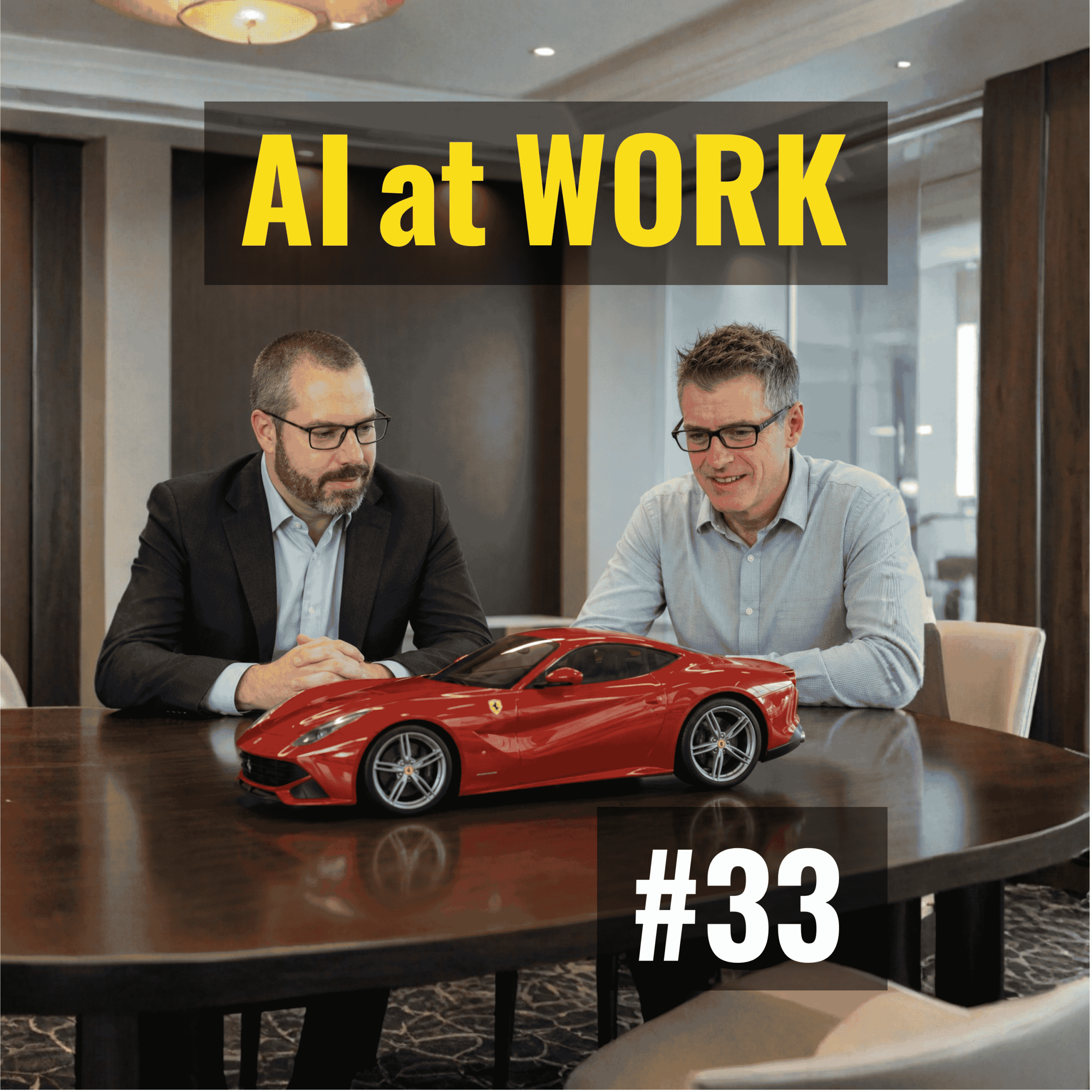
Wyatt Barnett runs AI at an 80-person trade association with no engineering staff and no CTO and he’s built more working AI capacity than most companies twice his size. The model is simpler and more replicable than you’d expect.
Wyatt Barnett is Head of AI (Technology Enablement) at the NCTA, the Internet and Television Association in Washington, D.C. In this conversation, Kevin and Wyatt get into the Tiger Team model Wyatt built from scratch ten cross-functional people embedded across departments, authorized to catch problems early, run experiments, and start solving things before they become formal requests.
They also cover tool selection for mid-market orgs, token cost management, why the AI engineering community is shifting focus from frontier models to the surrounding tooling ecosystem, and what Wyatt would tell a CEO who wants to build this kind of capacity with a blank slate.
Key topics covered:
✅ The Tiger Team model: how to build AI capacity without hiring engineers
✅ Why forward-deployed problem-catchers outperform centralized IT approaches
✅ Tool stack for mid-market orgs: Notion, Airtable, Claude, and what’s actually working
✅ Token cost management and the real budgetary risks of AI at scale
✅ What Wyatt observed at the AI Engineer World’s Fair and what it signals about where the industry is heading
Kevin Williams · Passage 1Hey there and welcome to AI at work. This week I have my friend Wyatt Barnett, who actually sits in the seat that a lot of our listeners want to have in their organization. Wyatt is head of AI for the NCTA, which is the Internet and Television Association in Washington, D.C. And I know Wyatt through various builder communities where we've become friendly over the last few years. Where people get hands-on keyboard doing a whole bunch of experimentation. And I'm really excited to have Wyatt on the show today because he builds build brings a real practical professional view on what AI infrastructure needs to be in moderately sized organizations today. He's a builder and a developer himself. and he is a huge evangelist for the technology. So, Wyatt, thank you so much for being on the show today.
Kevin Williams · Passage 3So, you know, the other reason that I wanted to have have you on the show is that you just came back from the AI Engineers World's Fair in San Francisco last week. So I guess sort of describe the lay of the land, what these shows are, and how they've evolved over the last couple of years, I think could be interesting. And the types of things that are going around in the hallways of true practitioners.
Wyatt Barnett · Passage 4Yeah. So the AI Engineer World's Fair, it's you know, it's kind of a it's a venerable event in the kind of scale of modern AI events. You know, it's been around a couple years, which puts it ahead of its peers. I haven't unfortunately cannot make the first few editions, but I did make this one. It was out in San Francisco at Moscone, if you've ever, you know, ever heard of the place. They last year they were in the ho one of the hotels, so it's kind of a lot bigger and a lot grander, which really maps with the industry these days. you know, you can see it in the rooms there. They, you know, it used to be a lot of people from OpenAI and Anthropic kind of talking about what's next and talking about the new techniques. This go-round, it was really much more tool vendors talking about what they're doing and how well they can work with, you know, work with in Anthropic and OpenAI's ecosystem. It's kind of interesting. I was there when Fable got re-released, and there was absolutely no buzz about it. Like it wasn't on the radar. People were much more worried about, you know. building better harnesses and how to manage their token spend and how to manage their context. the one thing, you know, in terms of token spend, I think they were kind of worried about and they're not worried, looping was a big construct people were into. and I can see how that could really ramp up your token spend visa kind of going from a point point where you're like, hey chatbot do this to hey chatbot, keep doing this until it's perfect, which could cost you a lot. But yeah, it was it was a pretty amazing event. I think, you know, real big the tet headline again was, you know, not a lot of AI event, you know, not a lot of big labs, but a lot of the vendor community in the room talking about it.
Kevin Williams · Passage 5Okay. so what do you think the vendors were pushing the most? Like what i it's always an interesting indic indicator from consumerism perspective to see what is being sold the most because somebody's getting market signals that that's needed, right? So what are the vendors pushing the hardest?
Wyatt Barnett · Passage 6you know, top line there are a lot of people trying to, you know Token maxing was this huge trend or fad for the last six months where you try and use as many tokens as possible. but now you see a lot of engineering companies really worried about token spend. You know, when you start kind of throwing every ticket into a massive AI loop, that starts to add up really fast. a lot of people have been consuming their entire budgets over the last, you know, in the first quarter. so a lot of a lot of vendors doing token spend. on the flip side, you know, probably more practical for the readers. Year, you're starting to see people work really hard on building the kind of harnesses and context management dedicated for you know different lines of business. I spent a lot of quality time in the kind of web 2.0 world where that grew up. And this this feels like a much faster moving version of that. You know, we're we're sitting here somewhat like 2010, where it's clear you don't need to go build another another LLM or you know, in that came venue it was you don't need to go build a new social network, right? Those had won the war at that point. But the surrounding ecosystem is still a huge question and that's where people think the money is.
Kevin Williams · Passage 7So elaborate a little bit on that. So you're talking about like context graphs and agentic harnesses that pull together different pieces of information from across an organization. Is that is that the direction that you're going?
Wyatt Barnett · Passage 8Yeah, exactly. Like some one one peop one vendor we use is Box and Box is there, so can kinda speak to what they do. So Box sees themselves as, you know, this context graph for your whole business because everyone's living in unstructured files. I I know we are, I presume a lot of folks are. But Box is now building the agent the tooling where you can go build your agents in box and they can, you know, understand that, you know, folder that Susie has been filing every report in randomly for the last 42 years, for example. And you can build tooling and you know the idea is you can build tooling on top of that. And obviously you'll be paying a big bill to box rather than open AI for doing this. But and you'll be, you know, I think locked in boxes ecosystem is the other thing these vendors are really going for. you know, it's one thing. we're working hard on internally is how to build this and not become you know a long term you know just a long-term box subscriber but you actually own your data so big you know emphasis on that you know kind of from bigger stuff like box to kind of more focused tooling this was an engineering thing so it was kind of much more focused on dev tools and all but you can see this across the board where people are saying let's let's go build the next generation of SaaS based on LLMs.
Kevin Williams · Passage 9So I I I think this is important to wrap on a little bit because it's something that we struggle with organizationally a little bit, and not just internally, but within our client base. That that this idea that you need to be able to connect all of these different decentralized pieces of information such that you have context, such that you can pull it together, such that Sally's reports can be linked to John's reports for the same client.
Kevin Williams · Passage 11And that whoever the client manager is can have like a centralized view of all of that. And even if Sally has left the organization, you can pull information from all different parts of the organization. Like absolutely makes sense. And we build a lot of these for clients where we're pulling in Slack, we're pulling in email, transcripts where it's appropriate to do that. And often we'll call it an enterprise spine of all of this different information. And it's not easy. I'll t I'll tell you, you know that this isn't easy either to pull this off from a a technical perspective, but also just an organizational design perspective. And I guess what I'm getting at, if you're a box, or the other one that we bump into a lot is Glean on the larger side is one that does this. how the heck do you does box put this in a box? Such that this actually can be compartmentalized in a way that they can justify what's essentially going to be token arbitrage, right? So you know, I I love what you just said. You're you're resisting it organizationally because you smell the direction that this is going to go. That if you get locked into box or you get locked into glean, you you're gonna have a hard time getting yourself out. out of that and you're forever after going to be paying a retail markup on your the tokens that you're using in that environment and that could get really, really expensive and it's going to make your CFO twitchy. so but what would be the conditions that would make you happy making that that decision? Like what would box actually have to look like in order for you to be like, okay, well that's that's going to be good enough that this is worth the trap.
Wyatt Barnett · Passage 12So Nat G Box is probably one of those where we kind of got got there. I always look at it just not even the AI thing before, you know, even before we had these LLMs, I always look at it as will this vendor let me get the data out of this system? Right? Can I copy the files? Can I copy the primitives? I mean, obviously, like you're pulling it out and not everything 100% is gonna work, but you know, if they make it. So there is no way to actually get your data out of this and pull it into something else. I I have some serious questions about that. at the end of the day with box, right, it's all still your files, right? I can copy those files over to OneDrive and we still have the files. The special sauce and the LLMs and the agents, you know, at least you you've got the markdown, you've got your code. so I've I've got hopes there. You know, other things I've seen have been, you know. more complicated. Honestly, the AI labs are getting about as bad as they could, you know, they can be in this in this area. you know, open AI and open AI is really, really busy building features into the open A client to make you really want to use open AI, even though the The GPT versus Claude versus Gemini is probably pretty close to a wash for most people. But they really want you using, you know, having all your scheduled tasks there and having this personal relationship with their client tools that make it really, really hard to move people. Yeah.
Kevin Williams · Passage 13Well, and I'll say from my perspective that we do a lot of that with clients. So a lot of our education right now is focused around building that capacity to understand the baked-in agentic harnesses, be you in anthropic or be you in open AI. And lo and behold, a lot of it really does work pretty well as far as creating basic administrative assistance or executive assistance for people. it gets kludgy in a hurry when you're trying to do something a little bit more complicated. And you know, organizations are rarely convenient that way. Like everybody has something complicated that they're trying to do. but it is pretty relevatory when you can just go to the agent screen in GPT in particular. And and I'm a Claude fanboy, but GPT has done a better job with this visually, in my opinion. As far as leaning in, grabbing a really friendly template, click, click, click, set it up. Now you have something that's going to pull into your calendar, it's going to pull off your email. If you're in in in Microsoft land, it'll pull into Teams, et cetera. it's pretty good. And you're not wrong, right? That that of course that's their goal. And I I still it it begs the question of if a lot of organizations are still at that stage where they don't have a you. in place to actually build this stuff and they don't really have a great use case to use a me to build some really elaborate solution, then the logical course of action for them is to lean more into the existing agentic harnesses, bring their people up to speed. And you know, I it's going to be pretty good for this point in time. I don't know. Agree, disagree? What's your opinion?
Wyatt Barnett · Passage 14Yeah, I think, you know, for for a non expert, like especially smaller, smaller scale, if you're trying to go, just, you know, kind of picking an ecosystem and sticking with it makes sense. Like I I'm doing this on a PC. I I live my life most of my life on PCs. I have no problem with Macs. And often when people are like, Hey, you know retiring, what kind of computing decisions should I make? I'm like, This is what you want to do. Go get Gmail, go get Google Drive, then buy all your Apple devices and watch it all seamlessly work across each other. And don't you know, don't overthink it. You have the data, you own it in Google, you can move that around a bit, but there's no point in fighting the Apple ecosystem and, you know, keeping a PC and having an iPhone and then having an iPad and not being able to get your text message on your computer to do something.
Kevin Williams · Passage 15So major PSA though is that friends don't let friends operate on an iCloud email address in the Apple universe because it is just a nightmare as far as connecting Apple directly to the rest of these agentic harnesses. The Gmail piece is really important that Google is really easy to work with. If I walk into a a team that is It's a Google workspace team and they're just running Gmail and they're running Drive and they're running a Google Calendar, then everything just works. If somebody is running Outlook and Microsoft, it can get tricky in a hurry with layers and layers and layers of Microsoft approvals and getting into intra and figuring out all of that stuff. And then even then, Microsoft has most of it locked down, so it's a read-only basis. So if you want to like start being really productive with this stuff, still the best lane in is is in the G the Google universe. Although I don't care for Gemini. I want to be able to link either GPT or Claude into a a a G Suite type environment.
Wyatt Barnett · Passage 16Yeah, I I a thousand percent agree. If I had my druthers, I'd be shifting us over there. It just is it's really a better mousetrap at this point. So my theory on why all these things just worked with Gmail out of the box is that's what the AI labs are using. You know, they there's a big dog fooding tendency and th their entire world's in G Suite, so of course we'll make it work with G Suite first, and that's why you you got that and that's why the integration's so so great. but yeah.
Wyatt Barnett · Passage 18I think think you're you're very spot on. iCloud is not a great email provider. and moreover, that kind of front door is just important enough to kind of have independent of your device.
Kevin Williams · Passage 19Exactly. So if you're running into issues, dear listener, with your outlook, if you have just a Microsoft like personal outlook, or if you have an iCloud email address, I really would consider creating at least an alias or something like that. Because it it it is it's almost a deal killer to be using those two particular structures as opposed to a paid email through one of the structures. so back to the the the world's fair. Kind of calibrate here from not not not in an overly technical way, but help us calibrate a little bit about the moment that we're in. So you know, commercially we talked a little bit about the vendor pressures and things like that, but you were surrounded by your peers. Well, other than all of the vendors who are trying to sell you things, but like what what sort of is the vibe right now as far as the point in time where we are? And you also mentioned that Fable dropped, so there's a lot of noise. Ye y I find it little interesting that that didn't generate much of a buzz. but sort of what's the vibe in general in that community?
Wyatt Barnett · Passage 20Yeah, they I think it's one of excitement. I think I really do keep going back to that kind of web two point in twenty ten, right? It's there's a lot of commercial opportunity. The big giant piece is already settled with the you know not settled now, but you kind of you know whose lane that is. And you're really there, you know. There there's a bunch of people trying to create kind of this middle layer of tooling, which is what you actually touch, right? Or kind of beyond the point, you know, like there's a huge phase in, you know, web two point zero of kind of selling the concept that, yeah, the internet's really a commerce engine. People are really gonna buy things here, the social media stuff has value, and will drive eyeballs in sales. And we we're past that. Everybody knows that, yeah, the AI thing is real. We're, you know, we're gonna do this. I think there is some cautious trepidation. floating around that people, you know, it seemed really, you know, the token spend kind of big picture. And like, you know, there's a token arbitrage problem for people our size. And there is also this, you know, is this going to be worth it? At some point paying somebody to do something. and you know, thinking about an organization our size, a lot of this really boils down to how much of this stuff is actually written down?
Kevin Williams · Passage 21Is the juice for us to squeeze? like process and things like that that you can actually you can actually improve. So let let's pivot over that way. I guess describe your role, your professional role at the NCTA and sort of where you sit in the organization. And let's wrap on that a little bit because I was I was laughing before we were recording, this is a seat that everybody wants and you have a relatively small, like most CEOs I know want somebody who is a you who can own
Kevin Williams · Passage 23the AI function within their organization or at least heavily influence it and drive it ahead, as opposed to trying to kind of level everybody up in the organization and figure it out as as they go. and yeah, so so sort of explain what that role is and what your responsibilities are and we'll go from there.
Wyatt Barnett · Passage 24Sure, yeah. So at NCD I've been there a really, really long time. So I've kind of seen this from a lot of angles. I was interviewing there twenty six years ago, this around now, for a sense of scale. And I've kind of just historically done a lot of different technical things there. I start on the help desk, segued into websites, databases, content management systems, built a trade show or two in between. and these days I'm what running what we call technology enablement. So I'm the guy responsible for kind of, you know, new technology transformation. this started actually right before Chat GPT dropped, coincidentally. So we're it was, you know, the emphasis changed pretty rapidly, but the mission was the same, which is get you know, kind of get this organization, which is we're a venerable trade association. We've been around for 75 years, which is, you know, ancient for a trade association in DC. and we're focused on the internet and the television industry and, you know, how to abdicate for our members. And that ball hadn't changed a lot because really it's about talking to people, it's about pressing the flesh, it's about who you know, in fact, from a data perspective. Very little of this was data, other than some trade show specific stuff, until AI hit, because this is all in English.
Wyatt Barnett · Passage 26So it kind of created this unique opportunity at NCTA to leverage this stuff. Now, structurally, kind of where I sit as I am the, you know, as I said, I'm the running this technology enablement operation. So we're kind of we're not IT, we don't work for IT. I'm actually in the creative production department technically, because we're kind of creative IT. and so, but what it lets us do is kind of counterbalance the risk management angle. And help, you know, focus on what this could do versus, well, how much is this gonna cost and what it's gonna do? So we we spend a lot of time a looking outside at tools we aren't using, and frankly a lot of time, and I think a lot of people don't do this enough, is all the tools you've adopted have gone through radical transformations of late, you know, kind of big picture observation. When we started work looking at AI stuff, it was just Open AI and Chat GPT. Now we can legitimately use the same AI engines within the products we've been using for a while, right? You know, Copilot came in through office. Slackbots grown real legs of late. you know, Box has a huge AI thing, like their AI's you know. what they called it, but their AI thing actually makes box search work now, which is a nice ad. been our number one user complaint for years. so and then, you know, you've got other tools on top of this that really take it to a new level. Airtable Notion do it well. So I don't think I'm not sure if I quite answered your question. probably got a little rambly, but
Kevin Williams · Passage 27Well, I guess I guess I I think one piece that I didn't realize is that you're not in the CTO stack. is there a CTO in your organization?
Wyatt Barnett · Passage 28No, there is not. We we're, you know, I should say like we're about eighty people. We work in DC. It's, you know, from a kind of technology and measurement perspective, it's pretty challenging, in as much as unlike, you know, probably a good way to think about the organization is it's kind of like a high-end law firm, but we don't have billable hours.
Wyatt Barnett · Passage 30so most of our inputs and outputs are hard to measure because, you know, we're really there to kind of, you know, quietly make sure the right things happen or don't happen. And don't, you know, don't really have a huge, you know, we can't say we had this many meetings, you know, we sold this many widgets, it just doesn't exist. So kind of figuring out ways to measure the return on investment here, other than people can do more, has been a challenge.
Kevin Williams · Passage 31So if that's the case, is your role push or pull? As in, are you pushing solutions into the organization or are you pulling solutions out of the organization? So how how does your your roadmap form? Like how do you decide what are the projects that you're going to chase and what's the influence within the organization that makes that happen? And sort of what's the success criteria that the organization is looking for?
Wyatt Barnett · Passage 32Gotcha. So I guess, well, success has always been hard to hard to define. so I'll sidestep that. But the you know, the you know, it push or pull is a really it's push, it's catch and pull push. Right? On the one hand, you gotta be have your eyes out there. And like I run what we call the tiger team internally, where we've got about ten people from across the organization,
Wyatt Barnett · Passage 34That really helps with the catching part. You know, we kind of we essentially have a forward deployed engineer everywhere. And the important part of the forward-deployed engineering, or one of the important parts, is being in the room and being able to hear the stuff. You know, we we kind of can sense things happening before it goes from a department head had an idea that became a formal proposal that went out to the people they think should do it, sort of scenario. So we can catch that way and catch like. problems and things people want to do. and then the pushing is just, you know, you you and this is the main advantage to having somebody in my role versus just kind of stick it in IT, is I spend a lot of time looking out and kind of what's going you know, what's going on. Like we are in an engineering org, but I go to things like the AI Engineers Worlds Fair because that's that's where you see around the corner. Like and that's where you talk to the people actually building the stuff and what's in the art of the possible, which kind of drives t where where, you know, where you can practically be as an organization that doesn't really have a huge technical staff.
Kevin Williams · Passage 35So let's talk about your Tiger team a little bit. So it it that doesn't sound like it's a subordinate team. That sounds like it's like people through the organization that have a certain type of skill set that are closer to the functional role. So you might have what you were determining as a forward deployed engineer who's part of this broader influence team, the tiger team that sits near sales or sits near marketing or something like that. And the sales or the marketing lead understand the issue, but don't really have the time for the technical solution. So that person catches the issue and then what brings it back to you or the broader group for solutioning, or do they just lean in and start solving the problem?
Wyatt Barnett · Passage 36you know, I well, frankly, ideally, they start solving the problem. You know, I think at our scale, kind of having a, you know, having a whole bunch of, you know, kind of a requisition process, if you will, just means things don't happen, I think. but you know, hopefully they'll lean in, you know, or they'll kind of engage us, engage the rest of the group informally, like, hey, you know, so I'm running into this. How can we solve for this? What do we have? The other thing the Tiger team gives folks, especially an organization this size, is we have some resources, right? Like a lot of times like, it'd be great if I could use this thing to do it and it but they have to go through their department budget to find money for it. Whereas we kind of effectively have funded, great, we want to check out this tool to see if it, you know, we'll spend twenty bucks a month or fifty bucks a month to see if something will actually work to invest it, which is actually another another huge life lesson of running something like this. You're better off just buying cheap seats rather than going through this enterprise sales process.
Wyatt Barnett · Passage 38Most most most of these things have, you know, some kind of offering that's, you know, well under a hundred bucks a month per seat. So you can usually buy, I kind of look at it as a ones, you know, start with a one seat. Hey, does this tool actually do what it says it does? Then there's usually a five seat solution where you're like, okay, does it do what it says it does for individuals and do the collaboration features actually work? You know, and we can do this kind of at our pace with our tools rather than have doing it with an enterprise sales guy being like, Hey, have you made a decision yet? Ready to sign the contract? Ready to sign the contract?
Kevin Williams · Passage 39Well, let's I want to talk a little bit more about these forward deployed engineers. Like the you have an 80 person organization and you have 10 people who are who are enabled to do this. That is a huge percentage of your organization that have these skills. Who are these people? Where'd they come from? How did you or they build themselves up to the point where they could be useful?
Wyatt Barnett · Passage 40so I think I should say for deployed engineers, more the kind of sense of how they're deployed. They're not necessarily, you know, we we don't have a lot of internal engineering talent talent. That's been one of our challenges. Like, you know, kind of how do you build things that you can maintain, maintain when you don't have people to maintain it. but they're, you know, we kind of I should say the organization functions much more like the Holy Roman Empire than, you know, a typical organization. We've got eight or ten.
Wyatt Barnett · Passage 42Different departments that have, you know, very different roles and facing. So, you know, there's kind of or almost a separate, you know, separate entity in a way. So we basically we went through and we picked the right people. This started during the pandemic as an idea to kind of give people something to work on, but it was morphed a bit. So we just kind of picked the right person on the team. Usually it's kind of what I'd say the it's typically been the kind of senior advanced department. Coordinator, if you will, you know, not somebody who's kind of charged with managing the department's data and processes who isn't necessarily an executive. We're also very, very executive heavy. and they so it's kind of a mentality thing and a right seat thing. it's also been a great thing, you know, it's kind of an organization. Like ourselves, it's given a lot of these people opportunities to learn and do things and add things to the resume they wouldn't have necessarily been. So it's been this kind of recruitment's a bit progressive, but definitely retention tool. You know, is at a small organization. One challenge you have is how to, you know, we've got this great mid level person, but there's nowhere for them to go but out. So how do we keep these people entertained?
Kevin Williams · Passage 43So how do you build their capacity to their skill set? Like, you know, I I I I have a decent idea how you built your AI skill set. I know how I built mine. How are these these other people building their skill set? Is this defined? Are they vibe coding their way through their weekend? Like what what does it look like?
Wyatt Barnett · Passage 44Well we had one or one guy kinda took that up and Vibe cut his way through weekends and actually moved on to bigger and better things. So that that that worked pretty well for him. yet in general it's it's really a providing, you know, this is an official structure, so they're supposed to be doing it. There's dedicated time, right? They don't have to they can kind of say, Hey, I'm working on this for the Tiger team. we I spend a lot of time making sure these people see see important things that I see, or, you know, otherwise you know I I feel a little better about spamming these folks than the rest of the world. You know, just and the other thing we you know, we and also the support structure is like, Hey, you got a project, well, you know, I'm here now you know me pretty well and I'm here to kind of support you both in finding you tools and you know, if we actually need to code things out or, you know, help you architect something you don't quite understand, I'm I'm here for you. and one little successful program that's something everyone should steal is we've been doing these AI lab days with folks where it's pretty simple. It's like we go, hey, find a small problem, right up, hey, this is the problem I'm trying to solve, just like a paragraph, nothing crazy. Then go work on it. You know, here are some tools you can use, you know, kind of use any tool you want within the kingdom. And then we have just a little lunch and demo session where you kind of show your tool and spend 10 minutes talking about it. and it's been it's been really amazing because you kind of get people to take some gloves off and build tools they haven't normally been able to build and kind of gain some confidence. A lot of this is really a confidence exercise. That hey, I can build those are good.
Kevin Williams · Passage 45So if you had if you had to bet or or just sort of guesstimate of of those those folks that that are out there doing this, are they what percentage of their time is doing basically vendor identification selection and vetting? Like, okay, we're good, we we I see the problem. I see that box is a good solution to this, or this tool might be a good solution to this, and I've checked it out and it's good to go. Now I'm gonna equip you, the team, to do this, and how much of it is actually building? how much of it is vibe coding or creating things. I think you sort of said that at some point it gets handed off to you in order to do that execution if it turns into a build.
Wyatt Barnett · Passage 46no, it's good. So we spent a lot of time looking at vendors, but we kind of we got to a point where we got a pretty good stable of stuff, unless it's a kind of very specialized I need something to convert X to Y or you know. So usually it's you know, because we've got at the user surveys say we have too many tools, fundamentally. But so we we don't have to do that. It's really more I try and keep it mainly with them. I think where where I come in is A, sometimes like I want to do this and I can't figure out how. So I'll kind of help people work through a architecture, you know, the architecture exercise, okay, where does the data come from? What happens to it? How does it get from point A to point B? and then, you know, on you know, the idea is to build them up into people who can do this themselves at the end of the day. So we really want you know, we want training wheels, not a tandem bike.
Kevin Williams · Passage 47Okay, that makes sense. So, you know, you're a trade association, but any organization generally has a lot of the same functions. So it there's marketing, there's sales, there's constituent management, which would be client management, right? there's finance, there's HR, etc. So of all of these tools, what are your favorites? Like I think this could be really interesting for people to hear of what sort of a mid sized organization is actually leaning into. when you also have voiced a little bit of conservatism around it. Like what are what are the what are the winners here? And what are those that are like, or just focus on the winners, whichever you prefer.
Wyatt Barnett · Passage 48no, no, I think it's well, first it's a what you've got, right? Like for us, all our data is an outlook, you know, outlook is really fundamentally our function, our line of business database, if you will. Like we don't have orders, we don't have things, we have notes, people have an outlook. and making that in in calendar events and kind of the first huge win for everybody is get your IT shop to unlock that and let that work with your chat GPT. sorts of tools. And you know, at this point, I hope everyone's got everyone on, you know, at least the kind of pro version of either Claude or Chat GPT. And they have amazing capabilities just kind of out of the box once you connect those. The other flip side is they've also specially clawed, but now OpenAI has ruled out their office integration. And I live I live in a world where people's job is to create office documents at the end of the day. And so I will it is life changing when you can put a lawyer in Word with Claude with track changes on and have it work something over in a way. Now the lawyer's like, wait, I can manage this and manipulate it. It's in track changes, so I understand what's happening. And the the big fear most people have at the end of the day is this machine's gonna do something and I'm not going to understand it. So that that's been I kind of bucket that as just you using what you got. In terms of tools that we found that really bring this to life, Notion is something we're working on a lot to bring to a lot of folks. they got a lot of stuff right. It's it's it took me a year to wrap my head around it, effectively. It's not it's not the kind of thing you can kind of just start using and get much out of, unfortunately. Because they spent so much time making the primitives correct. And like once you kind of realize how you can build stuff up.
Wyatt Barnett · Passage 50But functionally, the killer feature now is they have this meeting notes, and I spend a lot of time in meetings, and it's amazing to have a recorded copy of your meeting notes. and so there's now a really good meeting notes feature. And because it's Notion, you can kind of easily like point and click turn it into a database. And then with Notion AI sitting on top of it, I can do stuff like, you know, every two this Tiger team. I don't have something that goes every week, say, look at the last four meetings, read the output. What should what should be on the agenda, which I use as kind of one of my inputs to build the agenda for our meeting. You know, what did I miss? And I also, it does kind of interesting psych, you know, teen psychology things. You could sit there and say, hey, what threads am I missing? Is there an undercurrent here? So it's been so that's been worth the price of entry. and the other, another one we've been loving, and it's kind of it's people say they're the same and they aren't, is air tables. I don't know if you use it at all, but you're yeah. Yeah. It's an amazing tool. It really is access in the sky. Like it lets you do most of the things you'd really want to do with the relational database. where it's also a very effective event store. It's actually become kind of our data orchestrator for a lot of this AI stuff because it just works at our level.
Wyatt Barnett · Passage 52But recently they've added Omni and they've added their AI stuff. So now I can actually on the front end, like I had, you know, built this little CRM for somebody. You can sit there and be like, hey, what was my last meeting with so and so? And what do we talk about? It doesn't have to go parse through Airtable to do it. You can just do it right in Omni, and Omni sees the data and gets the structure. and you know, there's a kind of the flip side to it is they've now integrated. chat GPT and all and the automations. So I've now there's a bunch of things where people want to do some kind of not really complicated data tagging and parsing work, but it would have required at least understanding how to marshal between the open AI and and the, you know, marshal between open AI and like write some JavaScript. And now you don't have to do that. so those are those are the two big ones. Yeah, three big ones here.
Kevin Williams · Passage 53so one of my observations would be that there's a lot of different ways of doing things. and so we tend to lean pretty heavily into ClickUp as in instead of Notion. ClickUp is a project management tool, but it has a lot of functionality that makes it super usable from a lot of different places, and its schema is well understood by the LLMs. So you can tab tag into ClickUp.
Kevin Williams · Passage 55As basically a data repository. And in fact, you know, where you're using Airtable, I may actually be tempted to use ClickUp in some way, shape, short shape, or form. or I may choose to use Supa Base or something like that instead of using Airtable. But Air Airtable's been a great Lego block tool for a long time. And I think it's really underappreciated as a tool. It's not terribly expensive to run and It it sort of feels like this again, like a Lego box of, wow, now I I it's not just a a cell. It's it, I can link to this via an API, or I can link to this via my MCP, or I can have a URL that links to it. And there are all of these flexible pieces to it. I find it really, really fascinating from a builder perspective because you know, three of us might be building exactly the same thing and we might have wildly different approaches to it and get to the same answer at the end of the day. and I I think that that's just going to continue as the technology continues to evolve.
Wyatt Barnett · Passage 56Yeah, no, no, the only reason we were using ClickUp is we happened to get onto Airtable, you know, fairly early on and then kind of stuck with it. And then Notion came in and, you know, we're Notion, you know, we're this kind of text-based business. So Notion where Notion really shines for us is it lets people have a kind of page that really feels like a page, but we can integrate it with the database and kind of win from both ways.
Kevin Williams · Passage 57It it hurts my brain a little, to be honest, just the way that Notion works. and you were saying it took you about a year to bend your own head head around it. I'll I'll say that our own approach is to go to the mono thread. So we're we we've sort of transcended needing a base camp and instead are using the LLMs if they are well connected to the rest of the data store as our base camp. So everybody in the organization has morning and evening prompts that they run in our case through Claude that's going to trigger trigger all of the things that are going on, all of the things that need doing in ClickUp or in HubSpot, follow-ups from email, Slack, nasty grams from me, whatever whatever it might be. And it's all front and center for them. And my in in in my opinion, that reduces switching cost. that if you can spend a lot of your day in the chat bot as that just this mono thread, you don't really need to go to the notion box as much as you might have previously.
Wyatt Barnett · Passage 58Yeah, no, think that's, you know, functionally where I'm trying to build the whole thing is I'm trying to get to a point where we have this is data, this is where data lives. The entire ecosystem of tools around it talks to the tool, you know, talks to the data. So if you want to be in Notion and work against that data store, great. If you want to be in Claude and work against that greatest data store, great. And, you know. If you wanna sit there and Outlook and work against it, great. Like I still think we haven't talked about is I think email is still a killer interface for many of your AI things.
Kevin Williams · Passage 59Yes, I I actually laugh about that myself. I just told somebody this over the weekend that if you want to oversimplify how you work with agents and AI processes, look at email because so many things in the rest of our world get triggered by email. It might be some platform that has a reporting function that goes into email. it might be some data source that goes in there, but it's relatively easy to tie into email. and being able to use it as a central store of information and then trigger things from there as opposed to trying to work your way into some custom bespoke piece of software that was built in, you know, nineteen ninety seven. just start with email and transform the data from there.
Wyatt Barnett · Passage 60Okay. Yeah, yeah, no, it's just I mean it's you know as you're building things, right? All these tools talk to email. So I've got a few things where it's like a forward an email to this, or you know, just like my task management now is I get things in email and I have something I can hey, add this to the tasks list, you know, not really important but should be there. make sure, you know, add other factors and it just kind of now it just works. Like I've been trying to get that there for decades and you know, I could get something at track the email, but it was useless. we just have the royal email, but now it can actually understand the semantics and add all the you know metadata I want.
Kevin Williams · Passage 61So I want to get to the art of the perfect in a minute, but we you've mentioned token costs several times. And in your particular seat, it's something you're obviously paying attention to in your organization. what does that actually mean to you given the sorts of projects that you're you're you're defining here and the types of things you're doing? to be honest, not much we've talked about so far feels like it would be a really deep token investment, either on the build or or on the inference, which is is the ongoing cost of of of running the platform. But sort of where are your thoughts in respect to that and where are you feeling the pressures from you know, a budgetary perspective?
Wyatt Barnett · Passage 62so yeah, I mean the the well, there's always budgetary per se you know, pressure on the C I think the CFOs are reading the other CFOs talking about Token costs. You know, for us, we're really, I mean, our costs are really much more seat costs. You know, it's like, you know, big question today is like, you know, how different are Claude and ChatGPT? And could somebody need both? I think the answer is yes, fundamentally, for a lot of roles. they are different tools, and it's good to be able to balance them off each other. And also, there's, I think, a just a little little interesting token math I've made is you can buy people Claude Max accounts. Or you can buy them a chat GPT and Claude account, and then they tend to balance a bit and not, you know, not run into the threaded you you need to come back in five hours message I get once every other day. So so that's cool. the what really worries me about token costs is the it's the price of success. Like we had one tool, we obviously read things from the FCC, so we built something that reads FCC.
Wyatt Barnett · Passage 64filings. These are big eighty, ninety page PDFs. So we actually we got to a point where we turned it on, we realized that yeah, turning this thing on is gonna cost, you know, a couple hundred dollars a day.
Wyatt Barnett · Passage 66Just to read all these PDFs and the real the fundamental value was reading all of it so we didn't miss anything. So you couldn't kind of pare it down. now we find a way to cut that off, cut that off. You know, I think a big thing most people can do is think about there's a lot of things that we want to do with the LLM because it's easy, but you could easily do without invoking an LLM. Like in this case, right, a big chunk of that was reading the PDF. So we found a different tool, PDF.co, if anyone cares, that is a fairly cost effective service that will read that does a lot of things with PDFs, including reading But you know, that took it that dramatically reduced that part of the cost. But still at the end of the day, it's like, okay, we make this thing and it works. And now we have to turn it on and run it all the time. And then that that's where that math starts to worry me a bit. Yeah.
Kevin Williams · Passage 67Did do you feel like that was a little bit sprung on you, or were you anticipating the token increases?
Wyatt Barnett · Passage 68You know, I guess it probably would feel a bit sprung on many people. Like I this has been something I've just been concerned about. I've you know, I'm old enough. Did you ever have dare back when you were in school, Kevin? Like remember that whole thing about how th there's gonna be some dealer that's gonna give you free things to get you hooked? You know, that never happened in that context, but AI vendors
Wyatt Barnett · Passage 70have been very, very good at get you know, SAS vendors before them. So yeah, I always kind of look at these things as a I'm not gonna try and use this feature unless I see a runway to actually pay for it long term.
Kevin Williams · Passage 71I think it's been a real challenge for in fairness to budgeting offices and offices of the CFO, that it's it's what you just said. wow, we need to c we we can now take all of this FCC documentation and we can review it. And previously, maybe sort of kind of, some people were looking at it, were people actually reading everything that came out? Well, you need to manage that with a business case. And like what is the business case in in if it wasn't really doing before? Sort of falls into this area of new capabilities. And you know, it it does take some creativity to be like, okay, it's going to cost us $200 a day, which is a lot of money on a monthly basis to do this, but it's actually still less than an FTE employee. So is there is there a balance here where we can create new capabilities that are creating new client solutions that are it's decreasing churn or whatever it is in our client base that's meeting our mission where everybody looks at it and says, yeah, yeah, shut up and take my money. Like it's it it it's cool. But when you don't do that lift, when you don't actually look at what you're trying to get out of whatever the process is, I think that's when people really get disappointed. Okay, y y you built a Ferrari that nobody cares about driving. Like why wh why'd you build the Ferrari in the first place? Because I could. I don't think that's a great answer.
Wyatt Barnett · Passage 72Yeah, though I mean the flip side is, you know, it's like that that old Henry Ford analogy, right? If I, you know, did what the customer asked, I would have made a faster horse.
Kevin Williams · Passage 73yes, yes, yeah, yeah yeah, exactly. okay, so I guess also structurally, I think that that, you know, you've been doing this for a little while. you were you were early to the plate. I mean, I think we met each other in 2023. and so now you've been in this leader leadership position in an organization which frankly sounds really interesting about the way that you and the team have built this Tiger team and and and whatnot.
Kevin Williams · Passage 75But if you had a blank slate and you know, for organizationist generalis of about the same size, how should this look from if you were talking to a CEO or a founder and you're like, hey, if you want a me to be really effective in your organization, this is what this should look like.
Wyatt Barnett · Passage 76that's that's a good question. I think first you probably need, you know, kind of senior staff level CIO, like it's just an important enough function in twenty twenty six that they should be at the decision table with the CFO, the CTO, and you know, your head of marketing and all. it's just it's a huge you know, fundamentally selling this. This is a force multiplier. Right. This is how how, you know, this is how you build productivity. This is how you make your people more effective, you know, for their weight. so probably organization the big thing is making sure that's, you know, there's a CIO and it's not kind of functionally reporting to finance and risk management because they're really different things. But I know in many organizations this size, like kind of all that gets lumped together, right? CFO owns back office, and this is back office.
Wyatt Barnett · Passage 78would be I think the flu the other thing is kind of empower and enable your people. Like, you know, the the good ideas aren't gonna come they're gonna come from your kind of lower middle management more than your middle you know, they're the ones who are gonna kind of think about things in new ways. I mean I started a lot of this stuff because I got stuck with hi, quiet here, take all these registrants and go check them. And like I don't believe I can do this, but a computer can do it better. So you need to need that kind of belief. You know, you need to hire, you know, kind of, you know, more technical talent than you think you would at an organization this size. would be would be a big thing, right? Like in a lot of this, we I deal with this a lot is you know, it's like, we just don't know, this isn't something we do. We're not a technology company. Everybody's a bit of a technology company now. and then, you know, kind of just the other thing is, you know, understanding what you want out of it. I think to your earlier point about, you know, you can build a lot of Ferraris just because you can build Ferraris pretty easily these days and it's it's pretty cool, but you need to kind of understand where you're going with it, both short and long term, you know, kind of what what you want to owe own. You know, because I think there's there's a lot of long-term, okay, what parts of the data do we really need to own and what tools do we really need to own versus what's a rental? And getting that right requires some strategy.
Kevin Williams · Passage 79Okay. So I'll sort of summarize a little bit that it sounds like you need you need real leadership buy in and that leadership buy in needs to be in enough of a tech vertical, be it CTO or CIO, such that it just doesn't get embroiled in in like risk quagmire type stuff. Nothing nothing against that. And certain organizations are absolutely going to have to lean into that. But I think that mere mortal organizations that aren't Dealing with super sensitive data or rocket science or medical data or whatever it is can all can get bound up over things that probably aren't as big a deal as they they seem like to some people. And then you need to have space for people to develop the skills that they need, but also couch that in some sort of an ROI focus so that they're focusing on the right things. Is that fair as far as a summary?
Wyatt Barnett · Passage 80Yeah. Yeah, create a lot of cheap experimentation would be the way I see it. Like usually one of those, you know, water water a bunch of flowers but don't don't end up, you know, kind of building a whole flower bed and dumping a lot of fertilizer to build some flower that just doesn't really grow there. If you want to take it out that way. But that's that's really the focus.
Kevin Williams · Passage 81Okay. So now put yourself in the seat of an organization that doesn't have a lot of technical capability. And you're a CEO, you have like forty or fifty people, you're doing whatever you're doing pretty well, and you're not really overly stressed out about, you know, huge disruption or whatever it is. I I at least find that companies that are likely to be disrupted are all over this. But there are a lot of companies that are healthy but could be a lot healthier if they leaned into this. where would you tell that that CEO to start? It's it's a new day.
Wyatt Barnett · Passage 82you know, I think, you know, for kinda healthy organization like that, and this is the way we'd start a few things, is what problem? What's the thing that you're spending a lot of time doing you don't need to be shouldn't need to be doing? What could be a lot better? Because we you've fundamentally changed the rules around these things. You know, we had a lot of we've had a lot of things where it involves educated human read this document and get this document to the right pile. And that's some you know
Wyatt Barnett · Passage 84Like we build a Twitter application that just does just that. And that was somebody's job. And now that person can do a lot more things because there's something that runs through this pile of a thousand tweets every night and puts them in the right buckets. So, kind of what kind of opportunities can you find like that would be the big one. I I would say disruption is something I'd be worried about, even if you don't think you're going to be disrupted these days. We've again we've inverted a lot of rules in 2026. It's not the same world we lived in. so a lot of these things, you know, your moat might not quite be your moat anymore. so I I would be a bit cautious about that if I was a CEO at one of these organizations.
Wyatt Barnett · Passage 86The other thing I think is look around your talent pool, right? You have people who are interested in this and people are already doing this. Because, you know, the technical, the domain knowledge is probably the expensive part to create here. You can kind of you can tech people up really easily, but you know, you you have people who know the business and know the ins and outs and know kind know your customers. So kind of finding that and combining it. Overall, I think if you want to kind of find an outside model to lean into, yeah, are you familiar with Ethan Moloch or Zoom you are yeah, but most of us in this line of business are, but he does he's been writing a lot about this concept where he has like the le leadership, the lab and the crowd.
Wyatt Barnett · Passage 88And that's really really works across the board, right? You need leadership needs to have bought, you know, needs to be bought in, needs to support stuff. You build the lab, that's what I'm really running, where we're we're the people trying things, experimenting and getting it out to people. And you need kind of leadership to support the lab and help the lab get the winners out amongst the crowd. Would be a way to paraphrase it.
Kevin Williams · Passage 89Cool. So Ethan Moloch is about to drop his new book, which is called Coexistence. The first one was cointelligence, which I've been advocating as a nice primer for people for years. So I'm eager to get my talents onto coexistence because it is all about the convergence of this. and you know, as as you know and I know, this technology is very odd in that it is it's pervasive. And that
Kevin Williams · Passage 91Coexistence with the technology and that type of mono thread that I was describing earlier feels like the direction we're going. So, okay, as we sort of close up here, what are what are things that you're building that you're excited about, either on a personal or professional level? I know you're a tinkerer and a geek. So like what are you building that that that you're you're excited about?
Wyatt Barnett · Passage 92So so the the one thing that's kind of excited me of late, and I've been working this problem a while, is I have this sub stack, Zeitgeist Distilled publishes every Tuesday and it you know I read wide and far and probably about a thousand different publications every week. And how this has worked for years is I take these publications, categorize them as a tool called Raindrop, which is amazing. And then I have this list of a hundred links that I need to parse through myself and go figure out what should be in the publication, how to position it, et cetera. So I've been trying to find ways to kind of automate this and have this help, you know, have these tools help me in this sub stack, which is funnel very manual, but largely about AI, fun funnily enough. And Claude Code finally got there, where I spent a Saturday with Claude Code and Raindrop having it use these MCP tools to kind of read the links and other tools to read this read the publication. And it actually built the rule set I could not describe myself, but had been acting on for the last, you know, year and put it set all together. So now I have a tool where I can sit there and say, hey, go pull the last week's links and give me this kind of like, give me the concept. You know, what am I not seeing? You know, what's what are the common threads in these things? And it kind of take, you know, took this publication process, which would take the better part of a day, and now it's down to a couple hours. because the tool do, you know,
Wyatt Barnett · Passage 94The drudgerous part of rereading through all these things and saying what makes sense versus the fun part I like of reading it up front and kind of tossing it in the right buckets.
Kevin Williams · Passage 95So the question I like to l ask everyone is what is the tool that you couldn't live without? I usually say that mine is dictation, whisper flow. You're gonna have to cry it from my cold dead fingers.
Wyatt Barnett · Passage 96That's that's a good one. these days it's it's probably clawed code for its ability to do thing, you know, you can build things in file systems and do a lot of things across, you know, more information or more sources than you could handle yourself on the top, you know, on the top level. You know, on the bottom. Yeah. That's that's I think where it is. I I use way too many tools. It's hard to pick one. I can't With that or like a I you know, I carried Android and an iPhone, like
Kevin Williams · Passage 97I mean I mean, in truth, I like I I I you'd have to create you'd have to pull Claude out of my cold dead fingers too. clod code or clod in all of its forms at this point. All right, why thank you so much. this is this is super interesting. if people want to follow your sub stack, where can they find you?
Wyatt Barnett · Passage 98So the Zeitgeist Distilled, news dot zeitgeist distilled dot com. If that's too much, if you just Google for my name, it should be one of the first things that pops up.
Kevin Williams · Passage 99Awesome. Awesome. Well, again, sir, thank you so much for joining us and this has been super fun.
Credit the named speaker and AI at Work by AscendAI. Link to the episode or the passage you quoted.
“Ep #33 The Head of AI Role Everyone Wants Doesn’t Report to IT.” AI at Work by AscendAI, 2026-07-09. https://ascendlabs.ai/podcast/ep-33-the-head-of-ai-role-everyone-wants-doesnt-report-to-it/